26/11/2026
Back to all articles
As artificial intelligence moves from experimentation to implementation, Luxembourg employers face a new organisational challenge: deciding which AI capabilities to develop, how to structure their teams and which specialists to recruit first.
For many organisations in Luxembourg, the question is how to use artificial intelligence to turn that potential into something operational. Developing an AI proof of concept is one thing. Integrating it into existing systems, ensuring data security, managing regulatory requirements and maintaining its performance over time requires a different combination of expertise.
According to Morgan Philips Luxembourg's 2026 AI Job Market Study, the Grand Duchy is entering a phase of more structured AI implementation. Yet the market remains relatively immature, with only a limited number of organisations having established fully developed AI operating models.
This creates an important challenge for employers: how do you build an AI team when the roles, responsibilities and organisational structures are still evolving?
The answer begins not with recruitment, but with understanding what the organisation needs AI to achieve.
1. Understanding Luxembourg's AI job market before building a team
Luxembourg's AI ecosystem is developing within a distinctive economic environment. Financial services, insurance, asset management, compliance, cybersecurity and professional services are among the sectors where AI applications are already becoming visible and where AI jobs in Luxembourg are appearing.
According to the Morgan Philips study, organisations are using AI for document automation, advanced data analytics, fraud prevention, anomaly detection and operational efficiency. Meanwhile, generative AI is progressively being introduced into legal, compliance, HR and IT functions.
However, the transition from experimentation to implementation remains uneven.
Some businesses are still assessing potential applications. Others are developing internal AI capabilities, introducing governance frameworks or seeking to integrate AI into existing workflows.
These different levels of maturity have direct consequences for recruitment.
A company experimenting with internal productivity tools will not require the same team as a financial institution deploying AI models across regulated business processes.
For Quentin de Lacoste, Senior Consultant specialising in Digital & Tech recruitment at Morgan Philips Luxembourg, this distinction should shape the hiring strategy from the outset.
"We increasingly see companies recognising the potential of AI, but the challenge is translating that ambition into clearly defined responsibilities. Before recruiting, employers need to establish what they want AI to deliver and which capabilities they already have internally."
The first recruitment decision should therefore follow an assessment of the organisation's technological maturity, business objectives and existing talent.
2. How should you structure an AI team in Luxembourg?
One of the central findings is that AI is not necessarily creating entirely new organisational models.
Instead, it is often becoming an additional layer of expertise within existing IT departments.
Traditional functions such as software development, infrastructure, data engineering, architecture and cybersecurity are progressively evolving to incorporate AI-related responsibilities.
This suggests that building an AI team does not always require establishing an independent department from scratch.
For many employers, the more practical approach may be to strengthen existing technology functions while introducing a small number of specialised positions.
What are the key roles in an AI team?
The organisational model presented in the Morgan Philips study identifies several complementary functions.
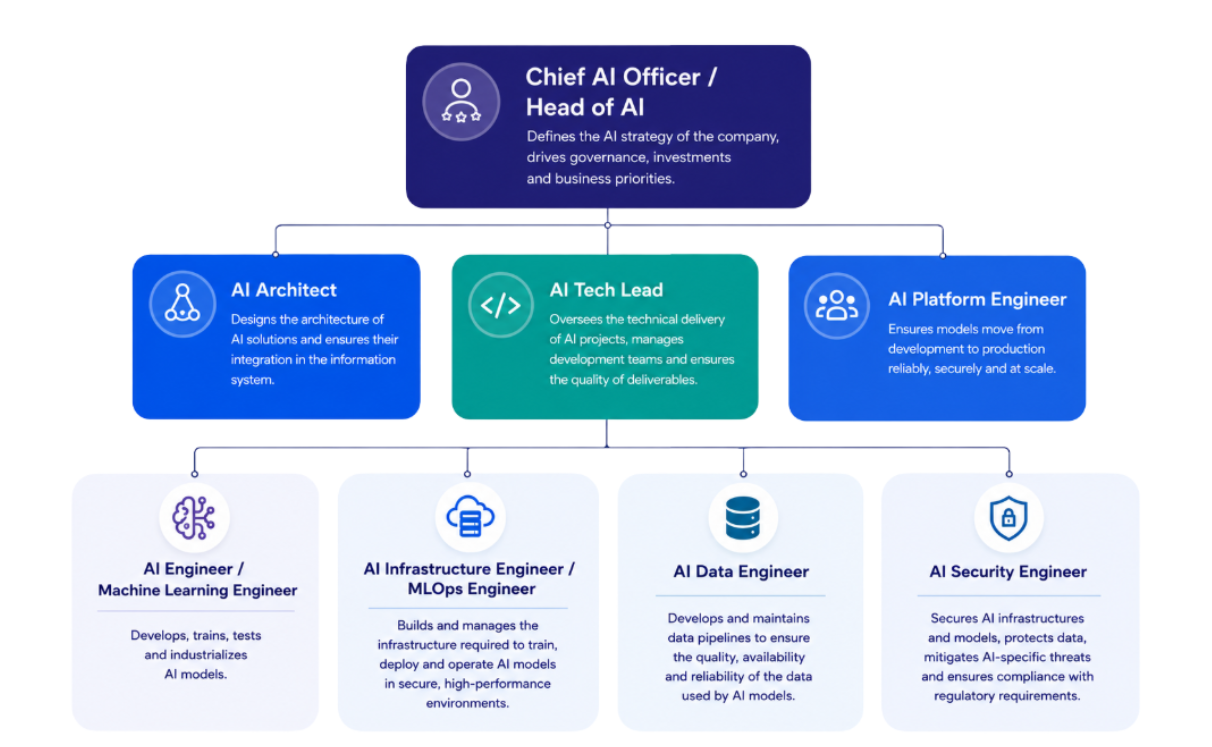
These responsibilities are complementary, but they do not necessarily correspond to separate hires in every organisation.
A smaller company may combine several responsibilities within one position. A larger organisation, particularly one operating in a regulated environment, may require greater specialisation and clearer separation of responsibilities.
The objective is not to replicate a standard organisational chart, but to establish an operating model appropriate to the business.
3. Which AI roles should Luxembourg companies hire first?
There is no universal recruitment sequence for building an AI team. However, employers can make more informed decisions by identifying the capabilities needed at each stage of implementation.
First AI hire: Head of AI or AI Engineer?
For organisations pursuing AI across several business functions, an AI Lead or Head of AI may provide the strategic direction needed to coordinate investment, prioritise projects and establish governance.
The position becomes particularly relevant when AI initiatives involve several departments, significant budgets or complex regulatory considerations.
However, recruiting a senior AI leader may be premature for a business with one clearly defined technical project and an existing technology leadership team.
In that situation, an experienced AI Engineer or AI Tech Lead may deliver greater immediate value.
The distinction is fundamentally one of responsibility: is the organisation looking for someone to define its AI strategy, or someone to implement an already established one?
"Hiring a Head of AI is not necessarily the right first step for every organisation. In some cases, a senior technical profile with strong delivery experience will have a more immediate impact. The right decision depends on the maturity of the project and the capabilities already available."
— Quentin de Lacoste
Second priority: Hire AI Engineers and Machine Learning Engineers
Once the objectives are defined, organisations need the technical expertise to develop and implement AI solutions.
AI Engineers and Machine Learning Engineers are central to this process.
Their responsibilities may include developing models, integrating existing AI technologies, testing performance and preparing applications for operational use.
The distinction between the two functions can vary between employers. Machine Learning Engineers generally focus more closely on model development and optimisation, while AI Engineers may have a broader role in integrating AI capabilities into applications and business systems.
In Luxembourg, recruiting these professionals is already particularly challenging.
Morgan Philips' 2026 study classifies hiring difficulty for AI/ML Engineers as Very High, with an observed turnover rate of 18%.
These indicators underline the importance of defining the position carefully and understanding the available talent pool before launching a recruitment process.
Third priority: AI Data Engineering and AI Architecture
AI initiatives depend on more than model development.
Organisations must ensure that their data is accessible, reliable, appropriately governed and compatible with the technologies they intend to deploy.
This is where AI Data Engineers and AI Architects become particularly important.
AI Data Engineers develop and maintain the pipelines supporting AI applications, while AI Architects define how solutions fit into the broader technology environment.
For businesses with complex legacy systems or fragmented data infrastructures, these capabilities may need to be developed before recruiting additional AI specialists.
A technically sophisticated model offers limited value if the organisation cannot supply it with reliable data or integrate it into its operations.
Fourth priority: MLOps, AI Platform and AI Security specialists
As AI applications move into production, operational reliability becomes increasingly important.
MLOps Engineers and AI Platform Engineers help organisations deploy, monitor and maintain AI systems at scale.
AI Security Engineers, meanwhile, address risks associated with infrastructure, data protection, model security and regulatory requirements.
These functions may become particularly important for Luxembourg organisations operating in financial services, insurance and other regulated sectors.
In some businesses, security and infrastructure expertise will already exist internally. The priority may therefore be to extend those teams' capabilities rather than recruit entirely new functions.
4. How much do AI professionals earn in Luxembourg?
Compensation is another important consideration when planning an AI recruitment strategy.
Morgan Philips Luxembourg's 2026 AI Job Market Study provides salary benchmarks for several key positions.
| AI position |
Annual gross salary |
| Head of AI / AI Strategy Lead |
€120.000-€200.000
|
| AI / ML Engineer - Experienced |
€75.000 - €95.000 |
| AI / ML Engineer - Senior |
€95.000 - €135.000 |
| AI Security Engineer - Senior |
€100.000 - €140.000 |
| AI Architect - Senior |
€110.000 - €130.000 |
Source: Morgan Philips Luxembourg, The AI Job Market in Luxembourg 2026. Experienced: 3–6 years in the role; Senior: more than 6 years. Annual gross salaries exclude bonuses and benefits.
These benchmarks demonstrate that developing an internal AI capability can represent a substantial investment, particularly when several senior positions are required.
Nevertheless, salary should not be the only consideration.
Employers must also assess the availability of candidates, the scope of each position and the organisation's ability to provide an environment in which specialised professionals can succeed.
For employers, presenting a credible project and clearly defined responsibilities can therefore be an important part of the recruitment proposition.
5. Why recruiting AI talent in Luxembourg requires a broader search strategy
Luxembourg's relatively small domestic labour market presents a structural challenge for employers seeking highly specialised technology professionals.
The local AI talent pool as scarce and highly international, with many of the strongest candidates already employed. This means organisations cannot necessarily rely on traditional recruitment channels or expect suitable candidates to be actively searching for new opportunities.
For specialised positions, direct sourcing, international talent mapping and a detailed understanding of candidate motivations become increasingly relevant.
The study also reports a 31% turnover rate for Head of AI / AI Strategy Lead profiles, alongside very high hiring difficulty.
These figures point to a market in which attracting experienced AI leadership requires careful preparation.
"Luxembourg offers interesting opportunities for AI professionals, particularly because of the complexity of its financial and regulatory environment. But employers are competing with organisations across Europe. Understanding where the relevant expertise exists, and what could motivate those professionals to consider Luxembourg, is an important part of the recruitment process."
— Quentin de Lacoste
For companies recruiting internationally, the challenge extends beyond identifying technical expertise. Candidates must also understand the business opportunity, the scope of the position and the practical implications of relocating or working in Luxembourg.
This is where specialist recruitment knowledge can help employers distinguish between profiles that appear technically relevant and candidates who are genuinely suited to the organisation's objectives.
6. Which AI roles and skills will be in demand in Luxembourg in 2027?
Looking beyond immediate recruitment needs, Morgan Philips expects the Luxembourg market to move progressively towards AI industrialisation in 2027.
This shift will require organisations to address a different set of challenges.
Rather than asking whether AI can support a particular process, employers will increasingly need to determine how to deploy it securely, efficiently and in compliance with applicable requirements.
The study identifies six positions expected to grow:
- AI Governance Manager
- AI Risk & Compliance Specialist
- AI Developer
- Machine Learning Operations Engineer
- AI Engineer
- AI Product Manager
The emergence of these functions reflects a broader evolution in the skills employers will need.
Technical expertise remains essential, but the ability to connect AI with business processes, governance, cybersecurity and regulatory considerations is becoming increasingly important.
This is particularly relevant in Luxembourg, where technology initiatives frequently operate within complex institutional and regulatory environments.
For employers, the implication is that future AI teams may require a combination of technical specialists and professionals capable of translating business requirements into practical, controlled AI applications.
Frequently Asked Questions
5. Why recruiting AI talent in Luxembourg requires a broader search strategy
The first AI hire depends on the organisation’s objectives, existing IT capabilities and AI maturity. Companies developing their first AI applications may prioritise an AI Engineer, Machine Learning Engineer or AI Tech Lead to support technical implementation. Larger organisations pursuing company-wide AI transformation may benefit from appointing a Head of AI or AI Strategy Lead to oversee strategy, governance and investment priorities. Assessing existing skills before recruiting helps employers avoid unnecessary hiring and build an AI team aligned with their business needs.
2. How much does it cost to hire AI professionals in Luxembourg in 2026?
According to the Morgan Philips 2026 AI Job Market Study, annual gross salaries for AI/ML Engineers range from €75,000 to €135,000, depending on experience. Senior AI Architects can earn between €110,000 and €130,000, while compensation for a Head of AI or AI Strategy Lead ranges from €120,000 to €200,000. These benchmarks exclude bonuses and benefits. Actual recruitment costs depend on seniority, technical specialisation and the complexity of the position.
3. What is the ideal structure of an AI team?
An effective AI team typically combines strategic leadership, technical development, data engineering, infrastructure and security expertise. Depending on the organisation's size and maturity, key positions may include a Head of AI, AI Architect, AI Tech Lead, AI/ML Engineer, AI Data Engineer, MLOps Engineer and AI Security Engineer. However, companies do not necessarily need to recruit every position separately. AI capabilities can often be integrated into existing IT, data and cybersecurity teams.
4. Why is recruiting AI talent challenging in Luxembourg?
Luxembourg has a relatively limited pool of specialised AI professionals, while demand is developing across financial services, insurance, technology and other industries. The Morgan Philips study rates hiring difficulty for AI/ML Engineers as Very High, with an observed 18% turnover rate. Many qualified professionals are already employed, making direct sourcing, international recruitment and competitive compensation particularly important for employers seeking experienced AI talent.
5. Which AI skills and jobs will be most in demand in Luxembourg by 2027?
As Luxembourg moves towards more structured AI implementation, demand is expected to grow for professionals combining AI engineering, MLOps, data infrastructure, cybersecurity, governance and regulatory expertise. The Morgan Philips study identifies six emerging positions: AI Governance Manager, AI Risk & Compliance Specialist, AI Developer, Machine Learning Operations Engineer, AI Engineer and AI Product Manager. Employers will increasingly need professionals capable of deploying AI solutions securely, integrating them into business operations and ensuring regulatory compliance.