13/04/2026
Back to all articles
As organisations evolve, many managers find themselves unprepared for the move from doing the work to leading people. The expectations have changed, but the support hasn’t always kept up.
Our recent webinar explored the coaching skills every modern manager needs to lead with confidence, support their teams effectively, and navigate today’s complex challenges.
Top Management Challenges in Today’s Workplace (And Why Leaders Struggle)
Today’s leaders and managers navigate a workplace defined by rapid change, digital disruption, and shifting employee expectations. During the webinar, attendees shared the challenges they currently face. There was a strong consensus, with challenges such as the following:
- AI and technology advancements
- Hybrid working and motivating hybrid teams
- Concerns around employee wellbeing and burnout
- Retaining employees
- Conflicting demands and pressures
- Time pressures
- Doing more for less
- Cross-generational working
- Pace of change
DDI and Forbes research shows that leaders are entering a period of heightened responsibility, increased stress and growing expectations from employees. Economic shifts, inflation, and rapid technological change also make long‑term planning difficult.
Why a Coaching Leadership Style Is the Solution for Modern Managers
The webinar highlighted that coaching isn't a nice-to-have soft skill; it is a practical toolkit for navigating daily challenges. By moving away from telling and toward asking, managers can empower their teams to solve their own problems.
Coaching skills and tools for leaders and managers
Coaching‑style leadership is linked to better communication, stronger teams, and higher retention, making it one of the most effective leadership approaches in modern workplaces.
Four key skills define a leader’s coaching approach:
- Active listening helps leaders understand the person and the situation.
- Emotional intelligence (EI) helps managers respond with empathy and clarity.
- Powerful questions help employees think, explore, and take ownership.
- Feedback and goal setting turn the conversation into progress and accountability.
What makes these core skills powerful is how they work together to create a leadership style that’s more human, more empowering, and far better suited to the modern workplace.
Active Listening: The Foundation of Effective Leadership Communication
Active listening is the foundation of coaching‑style leadership. It’s not only hearing words; it’s understanding meaning, emotion, and intent. It enables:
- Stronger trust and psychological safety
- Better problem‑solving because leaders understand the real issue
- More engaged employees who feel valued
What it looks like in practice
- Pause before responding and reflect on what you’ve heard
- Listen without preparing your reply
- Not jumping in with solutions
Emotional Intelligence: A Key Skill for Managing Teams and Building Trust
EI is the engine behind human‑centred leadership. It helps leaders manage themselves and understand others.
Why it matters:
- Modern workplaces are more emotionally complex than ever
- Hybrid work makes emotional cues harder to read
- Employees expect empathy, not authority
Emotional intelligence includes self-awareness, the ability to manage your emotions in challenging situations, and the skill to recognise and respond to the emotional cues of others.
EI in action
- Recognise your own triggers and stay calm under pressure
- Read team dynamics
- Respond with empathy rather than defensiveness
Powerful Coaching Questions: How to Develop Employee Autonomy and Performance
Powerful, open-ended questions unlock deeper thinking that shifts the leader from problem‑solver to thinking partner.
What they do
- Encourage ownership and accountability
- Help people find their own solutions
- Build confidence and capability
Effective Feedback and Goal Setting: Driving Employee Performance and Growth
Coaching‑mode leaders don’t avoid feedback; they make it constructive, continuous, and future‑focused.
Why it matters:
- Employees want clarity, not guesswork
- Continuous feedback cultures outperform annual review cultures
- Goal setting creates alignment and momentum
What good coaching feedback looks like
- Specific, not vague (linked to clear, achievable goals)
- Behaviour‑focused, not personal
- Balanced: reinforcing strengths and addressing gaps
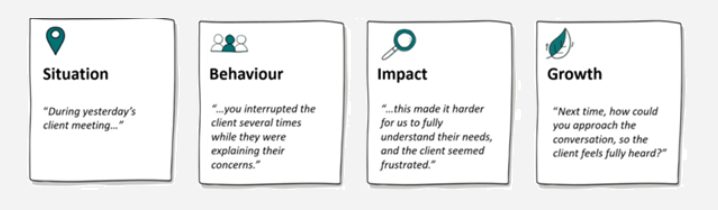
The SBI Growth Model is used in coaching‑style feedback. It’s simple, structured, and designed to make feedback both safe and developmental.
Practical Leadership Tips You Can Apply Immediately
The webinar focused on how shifting from a directive management style to a coaching mindset can help leaders unlock performance, build trust, and reduce pressure on themselves. Some takeaways include the following:
- Stop being the 'fixer': Ask "What is the real challenge here for you?" instead of providing the answer.
- Focus on the human: Prioritise soft skills to build trust and psychological safety.
- Use a framework: Implement a simple structure for your 1-to-1s to ensure they are development-focused, not only task-focused.
In under 40 minutes, you’ll gain practical tools you can use immediately in your 1-to-1s, team conversations, and day-to-day leadership. Lead better conversations, build stronger teams, and take pressure off yourself.
Frequently Asked Questions
What is a coaching mindset in management?
A coaching mindset in management is an approach where leaders think and act with openness, curiosity, flexibility, and a focus on empowering others. It’s the belief that employees have the potential to grow and solve problems when supported. Managers with a coaching mindset prioritise active listening and curiosity without judgement. This management style enables employees to take ownership of their development and build confidence.
Why is a coaching mindset important for modern managers?
A coaching mindset works for modern managers because today’s workplaces are more dynamic, collaborative, hybrid and employee‑driven. A coaching mindset creates stronger relationships, builds trust, and encourages continuous learning. Studies show that coaching‑focused leadership improves engagement, adaptability, and innovation. These are key capabilities in modern organisations. By moving from directive management to empowering employees, managers can boost motivation and performance.
What are the key coaching skills for managers?
Key coaching skills include:
- Active listening: Techniques include reflecting back and summarising. This involves being fully present and attentive to both what employees say (and what they don’t).
- Asking powerful, open‑ended questions: These questions encourage reflection, insight, and problem‑solving.
- Self‑awareness: Being self-aware means understanding personal biases, triggers, and assumptions. Managing one’s own reactions helps managers stay supportive and objective.
- Curiosity and flexibility: Managers approach conversations without judgement and adapt to the employee’s needs.
- Creating accountability: Accountability helps employees set goals and take ownership.
These skills align with the International Coaching Federation’s core competency of embodying a coaching mindset.
How does active listening improve leadership effectiveness?
Active listening strengthens leadership by improving understanding, trust, and communication. When leaders listen beyond the words, they pick up on tone, emotion, and unspoken concerns. This helps them respond thoughtfully rather than reactively. Research and coaching frameworks emphasise that active listening increases employee satisfaction, strengthens relationships, and enhances a leader’s ability to guide others.
What are the benefits of coaching leadership for employee performance?
A coaching‑based leadership style boosts employee performance by:
- Increasing engagement
- Encouraging ownership
- Supporting continuous learning
- Enhancing collaboration
- Improving innovation
These benefits collectively promote stronger performance and healthier, more collaborative team dynamics.